Research Benchmark

EgoInertia-MI

A Multimodal Egocentric Video and Inertial Dataset for Motor Impairment Analysis

1 University of Florence, Italy · fatemah.alhamdoosh@unifi.it, pietro.pala@unifi.it

2 Meta Reality Labs, USA · abduallah.adel.omar@gmail.com

3 University of Edinburgh, UK · D.Arvind@ed.ac.uk

Teaser figure for EgoInertia-MI

Abstract

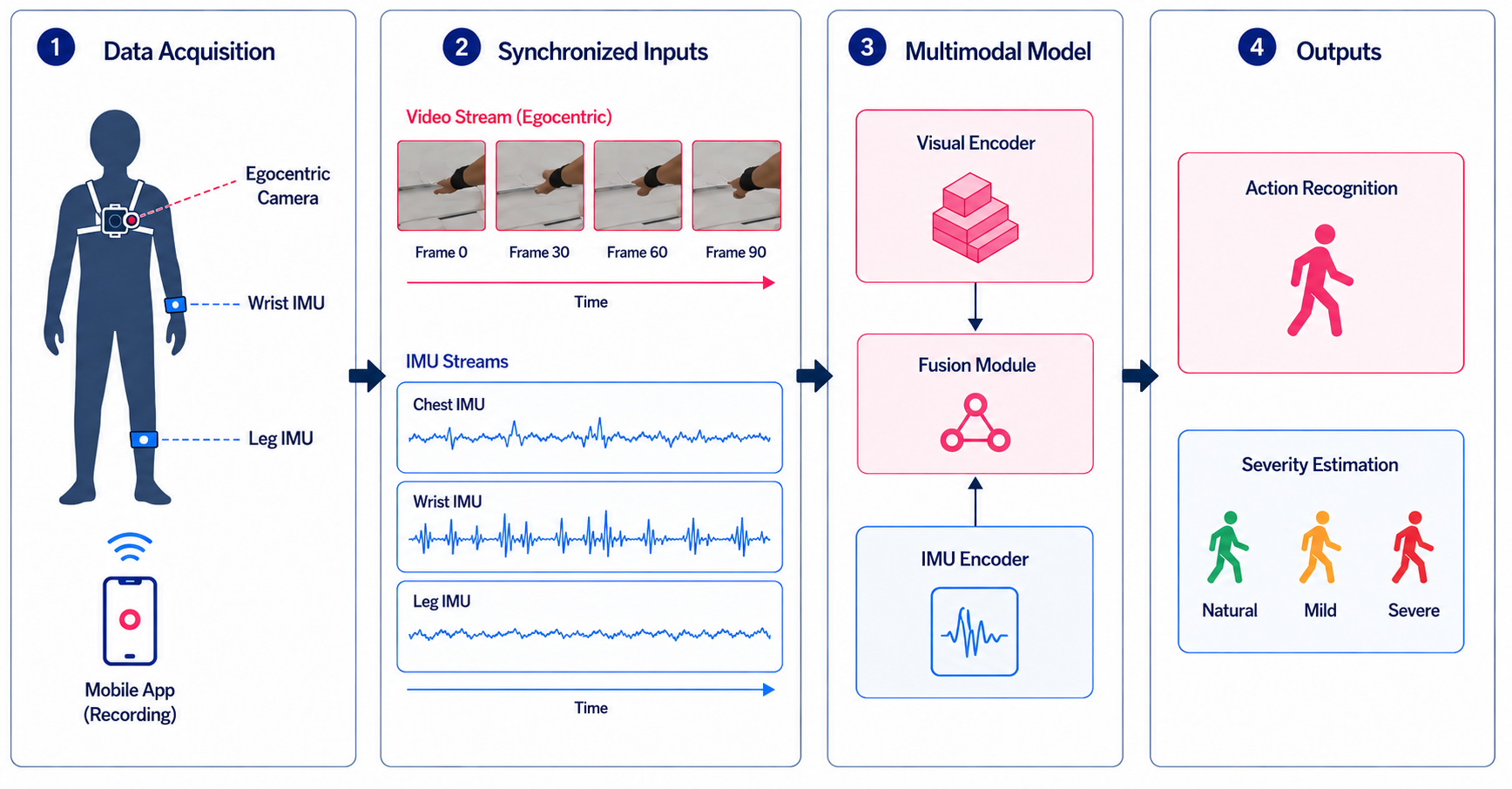
Motor impairments, including tremor, bradykinesia, gait abnormalities, and postural instability, are common across many neurological and movement-related conditions. Conventional clinical assessments are often intermittent and may fail to capture subtle temporal variations in motor behavior. While wearable IMUs and third-person video have shown promise for objective motor assessment, third-person recordings raise privacy concerns and require constrained acquisition setups. In contrast, egocentric vision provides a more naturalistic and privacy-aware alternative.

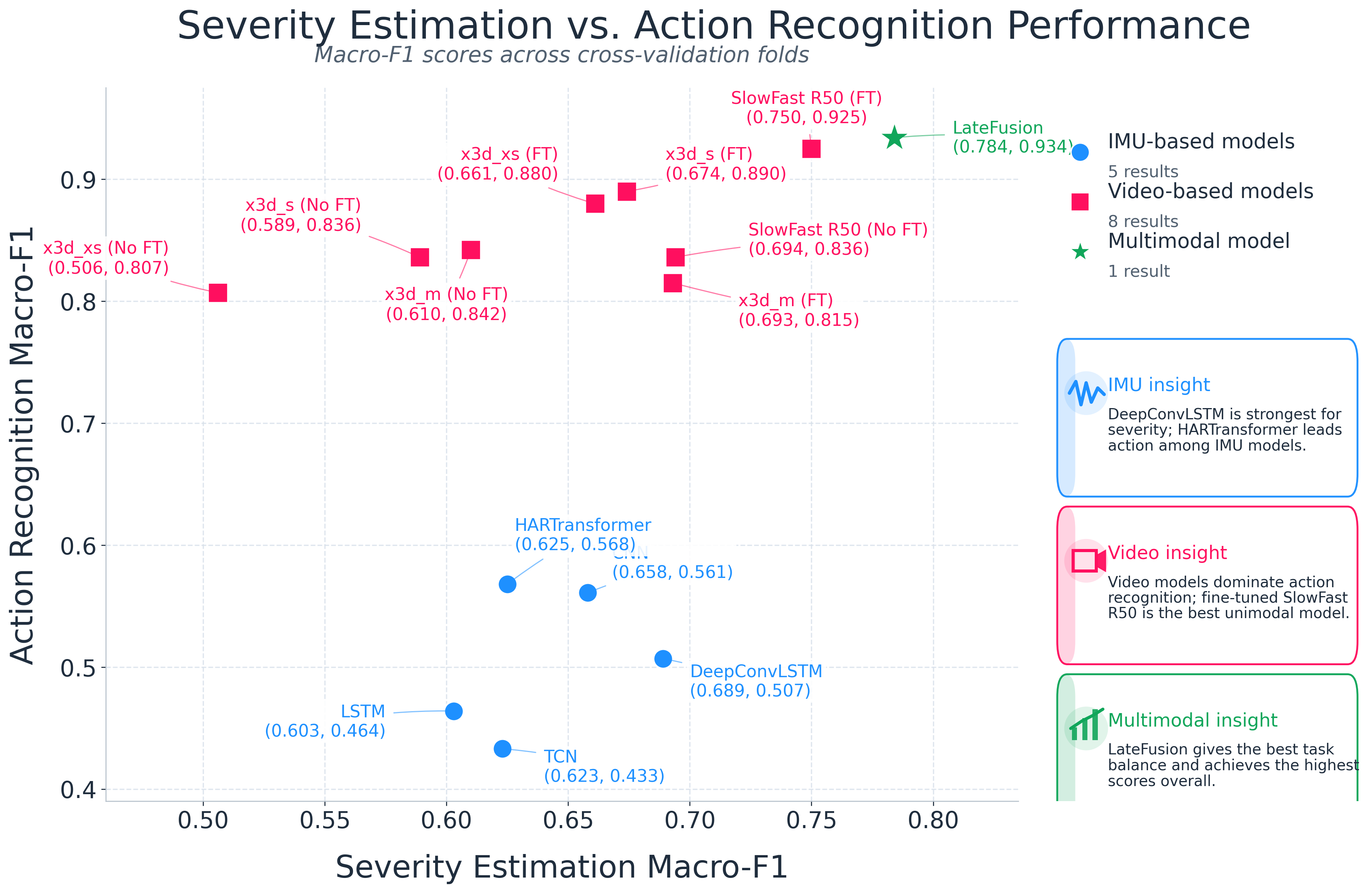
In this work, we introduce EgoInertia-MI, a multimodal benchmark dataset combining synchronized egocentric video and wearable IMU signals for motor impairment analysis. The dataset contains 19 upper- and lower-body activities performed by healthy volunteers simulating varying levels of motor impairment severity levels: no impairment, mild impairment, and severe impairment. We establish two benchmark tasks: action recognition and motor impairment severity estimation, and evaluate multiple unimodal and multimodal baselines. Experimental results show that egocentric video provides strong cues for motor impairment assessment, while multimodal fusion achieves the best overall performance, reaching 0.78 Macro-F1 for severity estimation and 0.93 Macro-F1 for action recognition. These findings highlight the potential of combining egocentric vision and wearable sensing for ecologically valid and privacy-aware motor assessment.
Dataset Description

Daily Activities and Clinical Tasks

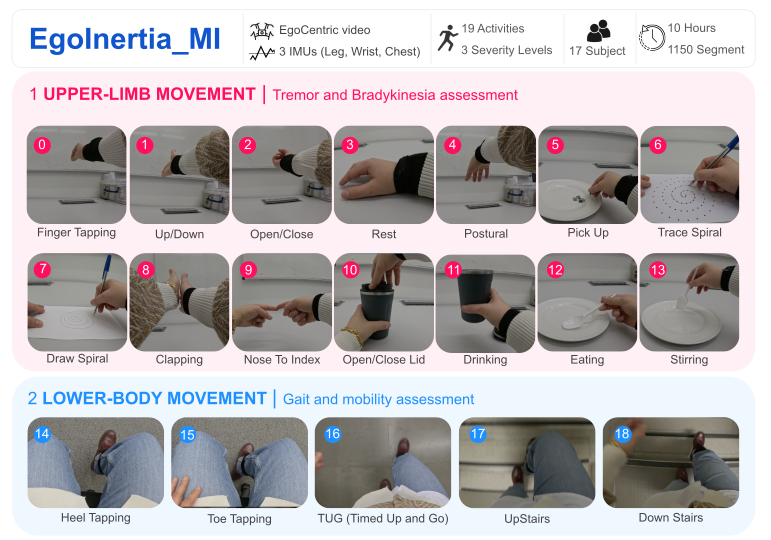
  • 19 activities spanning motor assessments and activities of daily living
  • Upper-limb, gait, stair navigation, and object manipulation tasks
  • Performed under Natural, Mild, and Severe impairment conditions
  • Designed to capture diverse manifestations of motor impairment
Overview of activities included in EgoInertia-MI

Multimodal Motion Capture

  • Chest-mounted GoPro HERO12 recording at 30 FPS
  • Wrist, leg, and chest IMUs sampled at 25.5 Hz
  • Synchronized video and inertial measurements
  • Captures both visual appearance and movement dynamics
Example IMU signals across impairment levels

Video Samples

Dataset Structure

The dataset is divided into two modalities: **Video** and **IMU**. Data are organized hierarchically by participant, session, and recording. Each participant typically completed 2–4 recording sessions, with each recording capturing a single activity performed at a specific impairment severity level. Corresponding IMU and video recordings are synchronized and share the same organizational structure.

Video Folder

EgoInertia-MI-video/
│
└── P0001/
    └── video/
        └── P0001_S1/
            ├── P0001_S1_V01.MP4
            ├── P0001_S1_V02.MP4
            └── ...
        └── P0001_S2/
            ├── P0001_S1_V01.MP4
            ├── P0001_S1_V02.MP4
            └── ...
        └── ...
└── P0002/
  └── ...
└── P0003/
  └── ...


IMU Folder

EgoInertia-MI-IMU/
│
└── P0001/
    └── aligned_IMU/
        └── P0001_S1/
            ├── P0001_S1_V01_aligned.csv
            ├── P0001_S1_V02_aligned.csv
            └── ...
        └── P0001_S2/
            ├── P0001_S2_V01_aligned.csv
            ├── P0001_S2_V02_aligned.csv
            └── ...
        └── ...
└── P0002/
  └── ...
└── P0003/
  └── ...
  

Identifier Mapping

Video: EgoInertia-MI-video/P0001/video/P0001_S1/P0001_S1_V01.MP4

Aligned IMU: EgoInertia-MI-IMU/P0001/aligned_IMU/P0001_S1/P0001_S1_V01_aligned.csv

Identifier format: PXXXX_SY_VZZ

  • PXXXX = participant ID
  • SY = session ID
  • VZZ = video ID

Standardized train/validation/test splits, metadata files, and benchmark protocols are provided.

IMU File Format

Each aligned IMU CSV contains synchronized wearable inertial signals with 19 columns:

rel_time_s,
w_acc_x, w_acc_y, w_acc_z,
w_gyro_x, w_gyro_y, w_gyro_z,
l_acc_x, l_acc_y, l_acc_z,
l_gyro_x, l_gyro_y, l_gyro_z,
c_acc_x, c_acc_y, c_acc_z,
c_gyro_x, c_gyro_y, c_gyro_z

Prefixes

w = wrist, l = leg, c = chest.

Signal Types

acc = tri-axial acceleration, gyro = tri-axial angular velocity.

Time Axis

rel_time_s is the relative timestamp in seconds.

Annotation

The annotation CSV is semicolon-separated and captures clip metadata, labels, and notes.

Annotation Columns

VidID;Path;HandInVideo;SensorsSideWristLeg;Action;Severity;ClassID;duration_s;notes
  • VidID: unique clip ID (example: P0001_S1_V01)
  • Path: relative video file path
  • HandInVideo: visible hand (R/L)
  • SensorsSideWristLeg: wearable side for wrist/leg (example: RR)
  • Action: activity label (example: FingerTapping)
  • Severity: simulated impairment level
  • ClassID: numeric class index
  • duration_s: clip duration in seconds
  • notes: optional comments

Dataset Statistics

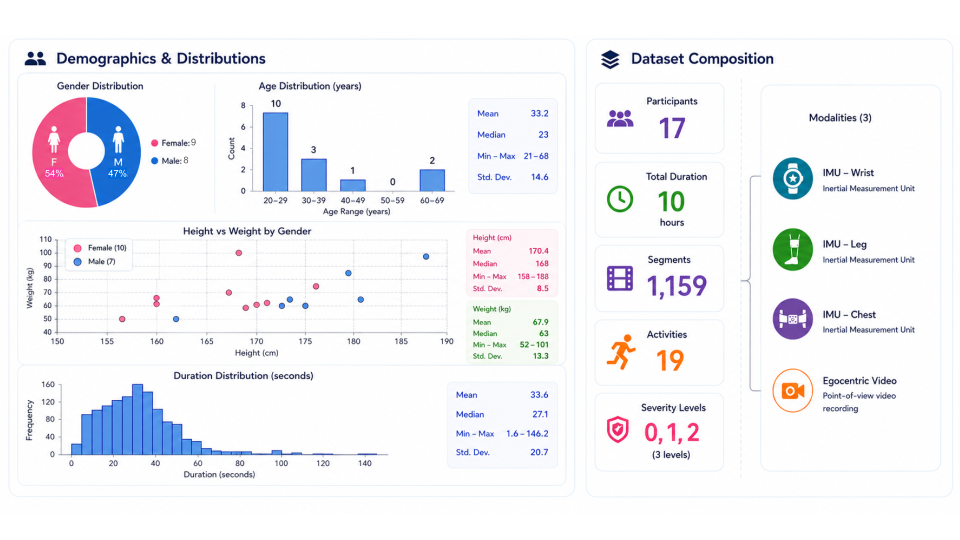
Dataset statistics

Benchmark Tasks

Task 1

Motor Impairment Severity Estimation

The primary task is movement impairment severity estimation from IMU, video, or multimodal data. Severity is formulated as a three-class classification problem (levels 0–2), requiring models to understand both motion patterns and their activity context.

Task 2

Action Recognition

The benchmark also includes action recognition across 19 daily living and clinically relevant activities. Actions are performed under varying impairment levels, requiring models to learn robust representations that generalize across diverse movement patterns and execution styles.

Evaluation Protocol

We adopt a 5-fold subject-disjoint cross-validation protocol with 12 training, 2 validation, and 3 test subjects per fold. Performance is reported using the Macro F1-score.

Baseline Results

Baseline results placeholder

Dataset Access

The EgoInertia-MI dataset is available through Zenodo under restricted access. To obtain the dataset, please submit an access request through the Zenodo record, including your name, affiliation, and a brief description of the intended research use.

Access requests are reviewed by the dataset authors. If you experience any problems with the access request process or need additional information, please contact Fatemah Alhamdoosh.

Please cite EgoInertia-MI in any publication that uses the dataset or builds on the proposed controlled data-collection protocol for studying impairment-aware movements.

Citation

@inproceedings{egoinertia_mi_2026,
  title     = {EgoInertia-MI: A Multimodal Egocentric Video and Inertial Dataset for Motor Impairment Analysis},
  author = {Alhamdoosh, Fatemah and Pala, Pietro and Mohamed, Abduallah and Arvind, D K.},
  booktitle = {ToDO},
  year      = {2026},
 
}

License and Ethics

The benchmark includes volunteer participants performing simulated impairment behaviors under approved study protocols. The design follows privacy-aware egocentric acquisition principles and is intended for research benchmarking, not direct clinical diagnosis.

EgoInertia-MI is a non-clinical benchmark and should be interpreted within that limitation. Ethical use, attribution, and adherence to the dataset license are required.

Acknowledgements

We thank all participants, annotators, and collaborators who contributed to the data collection and benchmark development process.